
A Fake Nextdoor Page Asked for My Credit Card. What Should Happen Next?
This is Part 1 of When Your Brand Becomes the Bait, a three-part series examining brand-impersonation phishing, security-reporting friction, and the privacy risks created when abuse reports are forwarded to suspected operators.
On Friday, July 31, I posted several items for sale on Nextdoor. Almost immediately, I received a direct message that appeared to be an official Nextdoor account notice. The message claimed that my listings had been hidden or suspended and that I needed to verify my account using a payment card.
The explanation did not make much sense. Not to mention that the message created urgency, and the destination was not on a Nextdoor domain. Those were real warning signs.
I followed the link far enough to understand what the page was doing, but I did not enter any payment, account, or personal information. The destination was a polished imitation of Nextdoor. I mean it used Nextdoor’s logo, colors, page structure, buttons, navigation, and footer. The site claimed that my account was “temporarily suspended,” that my advertisements had been hidden, and that I had 24 hours to complete verification.
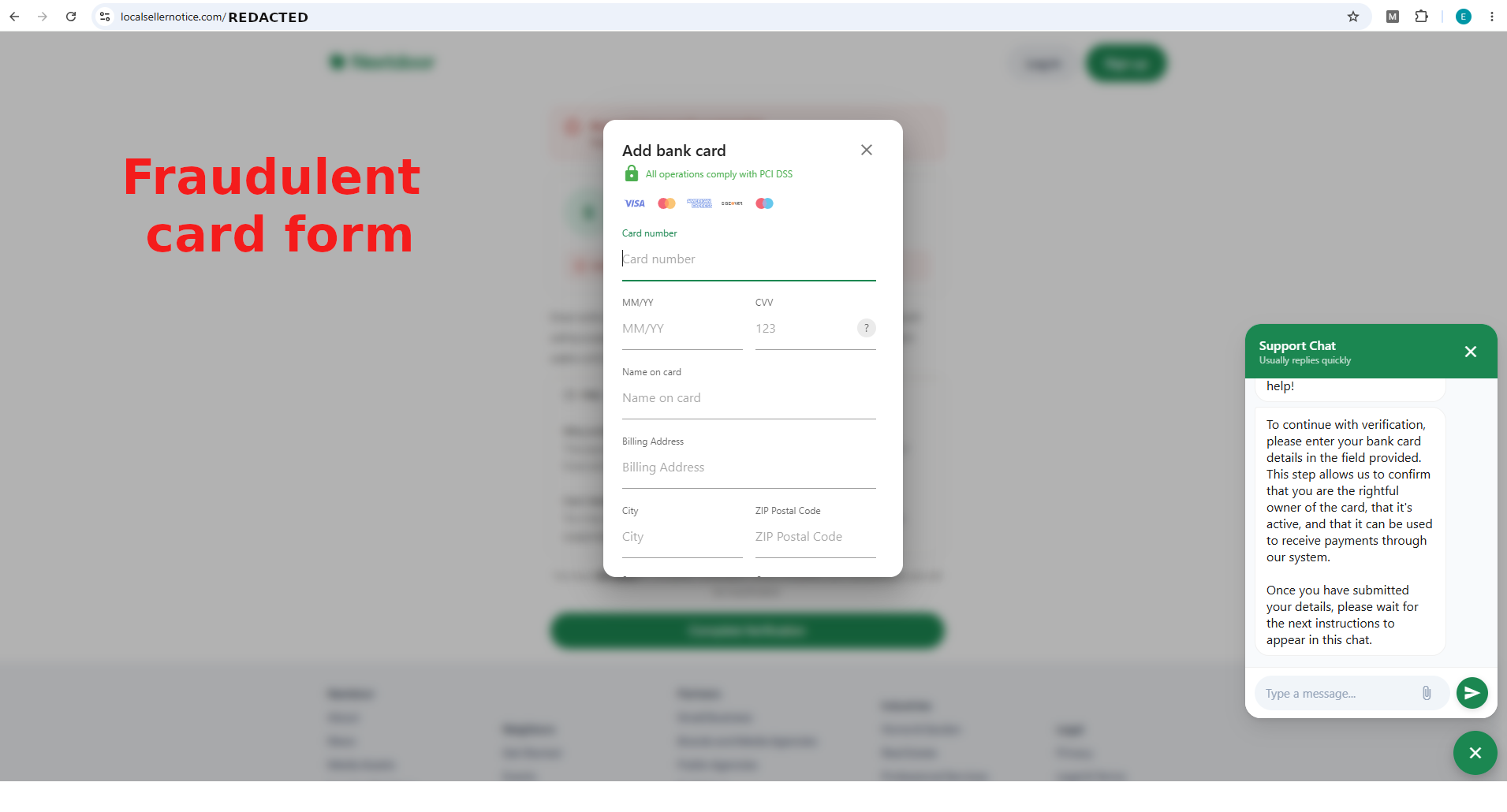
The final step requested a card number, expiration date, security code, cardholder name, billing address, city, and postal code. It even displayed a claim that the process complied with PCI DSS, the payment-card security standard.
This was not a crude message with misspelled words and an obviously broken page. It was a purpose-built payment-card harvesting operation that thoughtfully mimicked the Nextdoor look and feel.
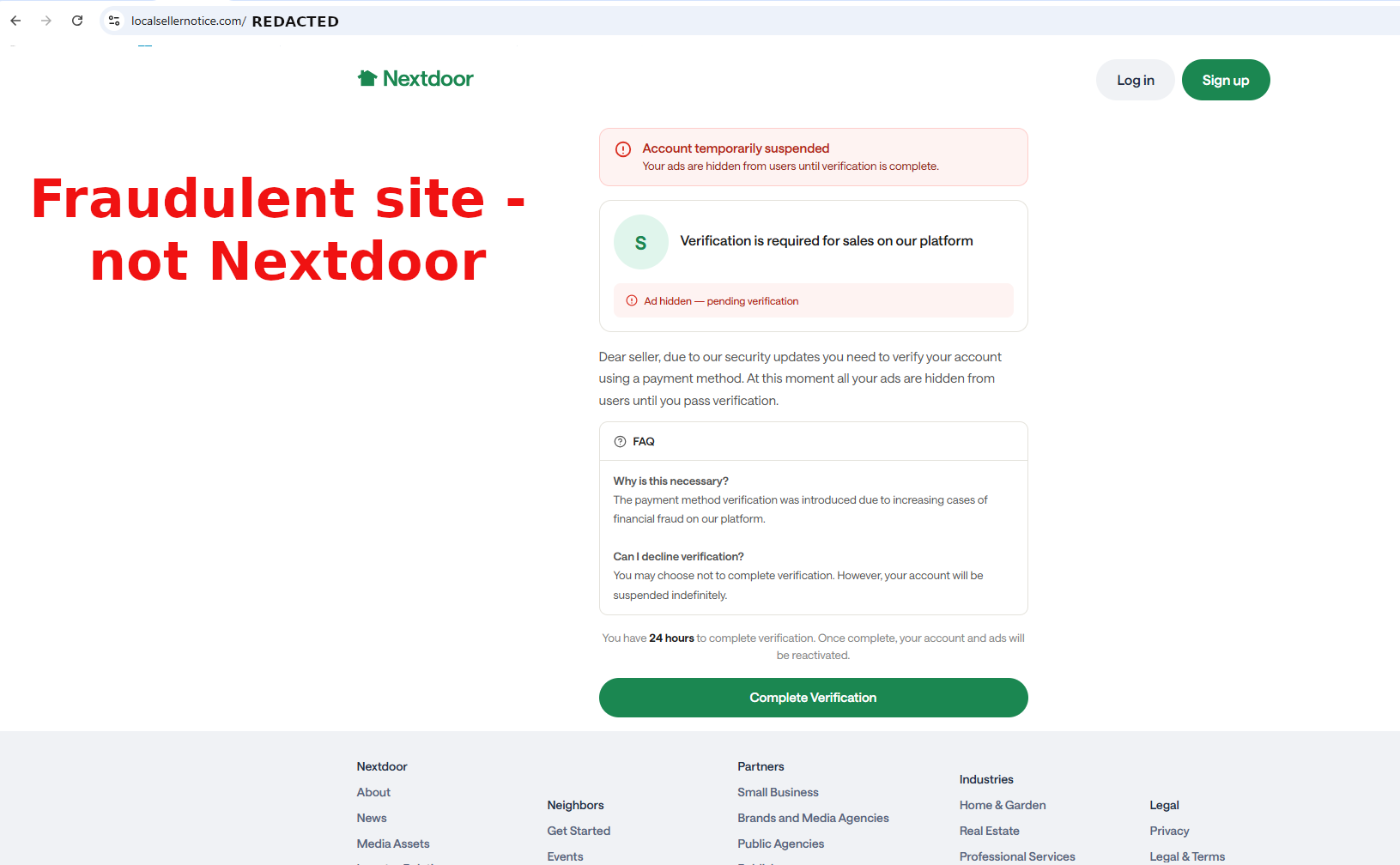
The page invented a payment system that Nextdoor does not offer
The phishing page did more than copy the appearance of Nextdoor. A fake support-chat panel told me that I needed to enter my bank-card information so the system could confirm that I was the owner of the card and that it could be used to receive payments.
Nextdoor later told me that it does not facilitate or intervene in transactions between neighbors. And that contradiction is important. The scammer did not merely imitate Nextdoor’s visual identity. The page invented a financial process, then used Nextdoor’s identity to make that process appear legitimate.
This is one reason brand impersonation is so effective. Most users do not have every platform’s transaction model memorized. If the page looks familiar and the timing makes sense, an invented policy can sound plausible.
Was this spear phishing?
A more accurate description would be listing-triggered brand-impersonation phishing. It may also qualify as spear phishing because the message was connected to an activity I had just performed. I posted For Sale listings, and almost immediately received a warning about those listings.
That is more targeted than a generic message claiming that an unspecified account has been suspended.
However, I do not know whether someone selected me individually or whether an automated system watched for new listings and contacted every seller it could identify. That distinction matters, since the attack may not have required deep research about me. Its effectiveness may have come primarily from timing. Sometimes personalization is not based on knowing a great deal about the victim. It is based on knowing what the victim did five minutes ago.
The domain appeared the same day
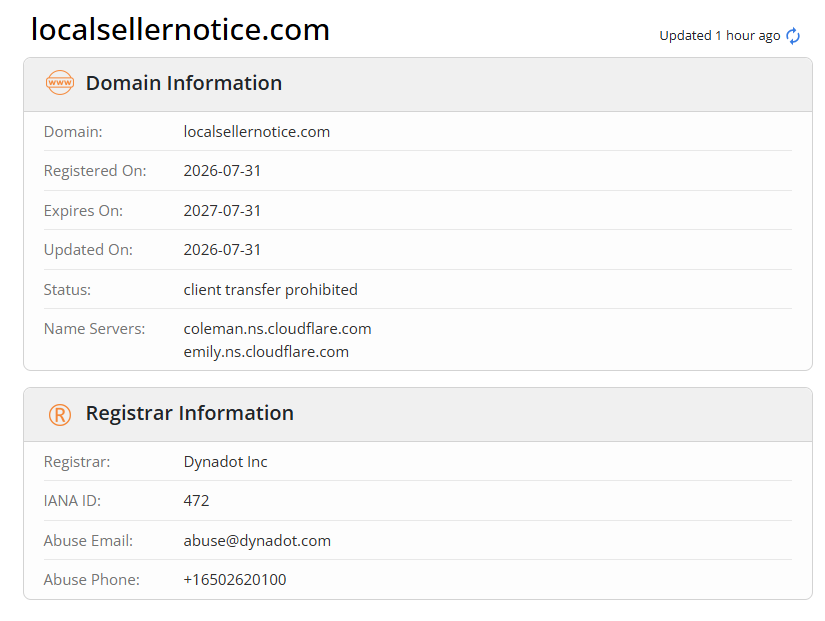
A WHOIS lookup showed that the phishing domain had been registered on July 31, the same day I received the message. That does not identify the person who operated it. It also does not prove that the domain was created exclusively for my incident.
It does suggest that the infrastructure may have been created for this campaign or a closely related operation.
I found the following to be notable about this combination:
- A newly registered domain
- A polished Nextdoor imitation
- Seller-specific language
- Delivery immediately after a listing was posted
- A full payment-card collection form
Then the evidence disappeared
I regret not capturing the original direct message immediately. I recognized that it looked suspicious, but I did not initially treat the message as evidence that might disappear.
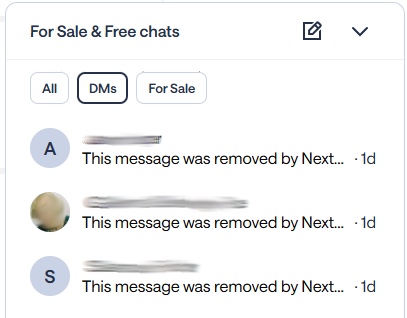
When I returned to Nextdoor the following day, the message was gone.
My message list showed three conversations marked:
This message was removed by Nextdoor.
Because I had not preserved the original message, I could not determine which conversation contained the phishing link. I also could not determine whether all three removed conversations were related. For what it is worth – all three messages were suspect in their own way from what I remember. One wanted to mail a check since they were moving to the area and I’ve forgotten what the third one was.
That creates an important evidence-preservation lesson:
Capture suspicious messages before assuming they will remain available.
A basic evidence package should include:
- The complete message
- Sender profile
- Message timestamp
- Full URL
- Browser address bar
- Email or push notification
- Screenshots before and after clicking
- The approximate sequence of events
A consumer should not need to perform a forensic investigation. But a few screenshots can make an enormous difference once the original content disappears.
What Nextdoor told me
After I reported the incident, Nextdoor told me that it had reviewed the activity and taken appropriate action on the account involved. It confirmed that the message was not legitimate. Nextdoor also said that it would never ask users for bank details to verify an account and would not send messages with external links regarding purchases or transactions between neighbors.
The company provided broader context as well. It said that Nextdoor neighborhoods had recently been targeted by phishing attacks and that attackers had used email and password combinations obtained from other websites to impersonate real community members.
Nextdoor said its own neighbor data had not been breached. That is another important distinction. An attacker can take over a user account without breaching the platform’s databases. Reused passwords or credentials stolen from another service can provide access to an otherwise legitimate account.
That would be an account compromise, but not necessarily a breach of Nextdoor’s own systems.
Nextdoor did not initially confirm whether the account in my specific incident had been compromised in that manner or created for fraudulent purposes.
What remained unanswered
I asked Nextdoor several follow-up questions:
- Was the account newly created or compromised?
- Was the message removed by Nextdoor or deleted by the sender?
- Did other users receive the same or similar message?
- Can Nextdoor identify who opened it?
- Can Nextdoor identify who clicked the link?
- Were those users notified?
- Were related accounts, messages, domains, and URLs investigated?
- Were message and delivery records preserved?
I also asked what the phrase “removed by Nextdoor” means.
The interface appeared to show removal timestamps matching the original message timestamps. That did not match my recollection that I had time to receive the notification, enter the site, and read the messages before they disappeared.
This may be a simple interface issue. But wording and timestamps matter during a security incident. “Removed by Nextdoor” suggests platform action. A message deleted by the sender would represent a different sequence of events. Security interfaces should communicate what happened as accurately as possible.
Should other recipients be warned?
I do not have evidence that Nextdoor experienced a reportable breach of its systems. And I am not claiming that breach-notification law necessarily required the company to warn users.
The more useful question is whether targeted notification would reduce harm.
Nextdoor should have access to information that I do not:
- Which account sent the messages
- How many messages it sent
- Which users received them
- Whether users opened them
- Whether users clicked the external link
- When the messages disappeared
- Whether related messages used the same domain or language
If a platform knows which users received a credible payment-card phishing message, it should seriously consider warning those users.
That warning does not need to imply that the platform was breached.
It could say:
A fraudulent message impersonating Nextdoor was sent to your account. It linked to an external website and requested payment information. The message was not from Nextdoor. Do not use the link or provide information. If you submitted card details, contact your card issuer and change any reused passwords.
Recipients known to have clicked could receive more urgent guidance.
The tradeoffs are real
Notification decisions are not always simple.
A company has to consider:
- Whether a warning will unnecessarily alarm people
- Whether users will incorrectly assume the company was breached
- Whether notification could interfere with an investigation
- Whether the warning could reveal detection methods
- Whether broad alerts will create support volume or alert fatigue
- Whether the available evidence is strong enough to describe the incident accurately
Those are legitimate considerations. The right answer may not be a warning to every user on the platform. A targeted warning to known recipients is a more balanced approach.
Good security communication does not require perfect information. It requires a clear distinction between what is known, what remains uncertain, and what users should do next.
How I would want my own site to respond
If a website I operated were used in a similar campaign, I would want the response organized around five stages.
Preserve
Retain the message, account, timestamps, recipient list, notification records, links, read status, click data, and deletion history.
Contain
Disable the malicious account, block the domain, locate related messages, and identify connected accounts or URLs.
Investigate
Determine whether the account was newly created, compromised through reused credentials, accessed through a platform flaw, or connected to a larger operation.
Communicate
Warn affected users when doing so can meaningfully reduce harm. Clearly distinguish an external phishing campaign, an account takeover, and a breach of company systems.
Learn
Review how the attack reached users, how quickly it was detected, whether evidence was preserved, how easy it was to report, and whether the interface communicated accurately. An incident is not fully resolved merely because an account is disabled or a domain stops loading. The organization should also ask what the incident revealed about its processes.
The larger lesson
The central issue is not that criminals copied a recognizable company’s branding. That happens every day. The more important question is what happens after the company learns that its brand and platform have been used as part of the attack.
A mature security response includes more than authentication systems, firewalls, and vulnerability scanners.
It also includes:
- Reporting channels
- Evidence preservation
- Interface language
- User notification decisions
- Coordination between Support, Security, Trust and Safety, Product, Legal, and Communications
- Respectful treatment of the person reporting the incident
The person reporting suspicious activity may not be a security researcher. They may simply be a user who noticed that something felt wrong. That instinct is valuable security telemetry.
Organizations should make it easy to turn that instinct into action.
Next in the series: Part 2 examines why security-reporting channels should be treated as security controls, and how broken or overly restrictive intake processes can delay containment.
When Your Brand Becomes the Bait
Part 1: A Fake Nextdoor Page Asked for My Credit Card
Part 2: Security Reporting Is a Security Control (coming soon)
Part 3: When Reporting a Phishing URL May Identify the Victim (coming soon)